
California’s healthcare landscape is shifting in quiet but meaningful ways. More physicians are finding themselves at a crossroads where growth, stability, and long-term planning all intersect. In this environment, conversations around selling to hospitals are becoming more strategic, shaped not just by opportunity but by how the system itself is evolving.
Understanding the California Healthcare Market in a Shifting System
The healthcare market in California has experienced steady consolidation over the past decade. Large health systems have expanded their outpatient presence by acquiring physician groups and integrating specialty clinics into broader delivery networks. This trend has been influenced by reimbursement pressures, administrative complexity, growth in value-based care models, and increasing activity from both hospital systems and non-hospital corporate buyers, including private equity–backed platforms.
In California, the Corporate Practice of Medicine (CPOM), which is rooted in long-standing state law rather than any single recent statute. The doctrine is primarily reflected in provisions of the California Business and Professions Code, including Section 2400, which restricts corporations and non-physician entities from practicing medicine or exercising control over clinical decision-making.
While hospitals and health systems commonly operate within compliant employment and integration models for physicians, they are still subject to the same underlying legal framework as other entities. As a result, all acquisition and employment structures must be carefully designed to ensure that clinical decision-making remains under physician control, even when operational or administrative functions are integrated into a larger health system.
The Shift Toward Hospital-Led Practice Acquisitions
For physicians considering selling a clinic in California, the market includes a mix of potential buyers, including hospital systems, physician practice platforms, and private equity–backed organizations. Hospital systems are often viewed as relatively stable long-term partners due to their established regulatory structure and alignment with healthcare delivery networks.
However, physician practice ownership trends reflect a broader national shift toward employment. According to the California Health Care Foundation report, physician employment patterns have shifted notably over time, reflecting broader structural changes across the healthcare system.
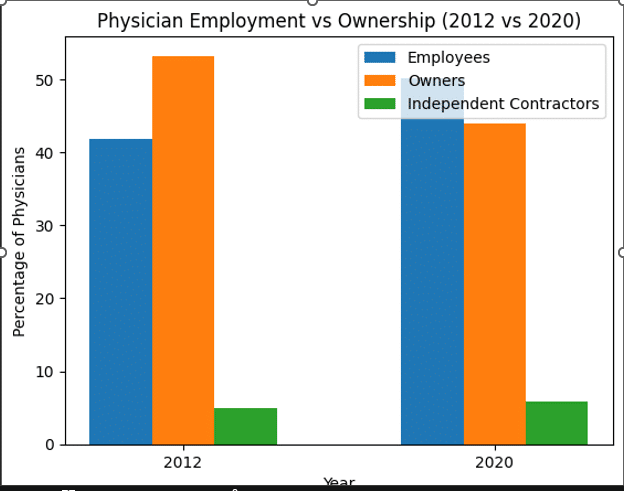
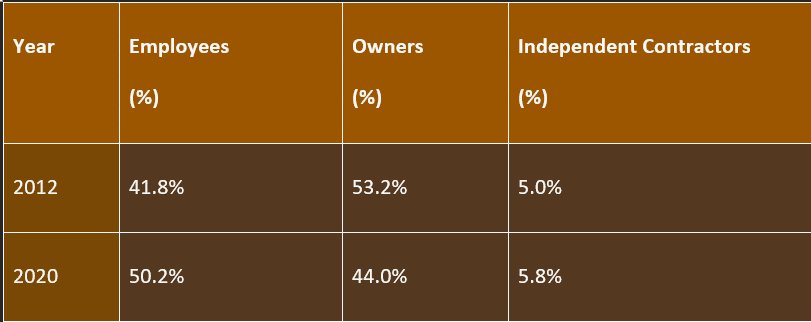
The chart compares physician practice status in 2012 vs 2020, showing employees increasing, owners decreasing, and independent contractors remaining relatively steady.
The share of physicians in private practice has declined over time, while employment by hospitals, health systems, and corporate entities has increased. This shift is driven by multiple factors, including administrative burden, reimbursement pressure, and the growing complexity of operating independent practices.
A Guide to Selling Your Practice to Hospital Systems in California
The clinic sale process follows a structured sequence shaped by compliance, valuation standards, and strategic alignment with health system goals. Hospital buyers focus on long-term integration potential rather than short-term profit alone. This means cultural fit, referral continuity, and staffing stability carry significant weight. They want to understand how your practice will function within their broader network, not just how it performs today.
If you are wondering, “What is the process of selling a medical practice to a hospital in California?” Here’s all you need to know:
1. Initial Readiness Review
Hospitals assess financial statements, patient demographics, payer distribution, and operational consistency before formal discussions progress. Clean records and organized reporting help speed up this stage, while gaps or inconsistencies can delay or even pause early interest.
At this point, buyers also look at physician productivity, appointment volumes, and revenue trends over time. A steady performance history often builds stronger confidence than sudden growth spikes.
2. Strategic Alignment Discussions
Early conversations focus on service overlap, regional expansion plans, and how the clinic fits within hospital service lines. This is where both sides determine if the relationship makes sense beyond numbers.
Hospitals may evaluate referral patterns and how your practice connects with existing specialists or facilities. Strong alignment here can improve the likelihood of moving forward into deeper negotiations.
3. Financial Valuation Review
Independent valuation models are used to determine fair market value based on earnings, assets, and projected revenue contributions. This step follows strict regulatory guidelines to maintain compliance with state and federal healthcare laws.
Valuation is not just about profit. Factors such as patient retention, payer mix stability, and operational efficiency also influence the final assessment and the overall deal structure.
4. Integration Planning
Hospitals in California evaluate staffing retention, electronic health record compatibility, and compliance alignment before final approval stages. Integration planning helps reduce disruption for both patients and staff after the transition.
This phase often includes discussions around physician employment terms, leadership roles, and how the practice will operate within the hospital system moving forward. A clear transition plan can make the final stages smoother and more predictable for everyone involved.
Why Hospitals Are Becoming Key Buyers of Physician Practices
According to an American Medical Association survey, nearly 80% of physicians reported that negotiating higher reimbursement rates with payers was a key factor in their practice being sold to or acquired by a hospital or health system, with 46.1% describing it as a “very important” reason and 33.4% as an “important” reason.
This dynamic also helps explain why hospital systems have become such dominant buyers of physician practices in California. As reimbursement negotiations grow more difficult for independent groups, scale becomes a practical advantage. Larger health systems are often better positioned to negotiate payer contracts and secure higher reimbursement rates, which in turn makes acquisition a strategic solution for both parties.
For many physicians, joining a larger system is therefore not just about operational relief, but also about gaining access to stronger payer leverage that is increasingly hard to achieve in independent practice.
Maximizing Value in Hospital Acquisition Transactions
Success in a clinic sales process depends on the quality of preparation, transparency, and timing. Physicians who organize financial and operational records early often experience smoother negotiations and stronger valuation outcomes.
- Maintain clear financial records covering revenue cycles, payer breakdowns, and operating expenses for at least three fiscal years
- Stabilize staffing structure to reduce buyer concern about continuity after acquisition completion
- Strengthen referral consistency by documenting patient flow patterns and specialty demand sources
- Align clinic services with hospital expansion priorities in regional healthcare planning reports
- Prepare transition plans that outline patient communication and care continuity approach
- Review compliance documentation carefully to reduce risk flags during due diligence reviews
Each of these factors directly affects buyer confidence and final transaction structure.
Professional support from medical practice brokers can help align clinic readiness with buyer expectations. Strategic Medical Brokers assists physicians across California with transaction planning, buyer introductions, and negotiation support, all designed to support long-term financial clarity and operational transition stability.